On this page
Short answer
If you want the deepest personal GTD system, OmniFocus is still the benchmark. If you want the most pleasant personal app, Things 3 is hard to beat. If you need sharing across Android, Windows, and the web, Todoist is the realistic choice. If a shared list is enough, Apple Reminders is free and already installed. DuetFlow is for the gap between them: real GTD for the person who organizes, with shared tasks that know who owns them, for everyone in the household, on Mac, iPhone, and iPad.
The question most comparisons skip
Feature grids usually compare tags, filters, and themes. In a household, the question that decides whether a system survives is simpler: when a task appears, does everyone know whose it is? Picture Alex capturing “book the plumber” in a personal app. Sam never sees it. Alex sends a text, Sam replies “I can do Thursday,” and the task now lives in a chat thread, Alex’s app, and Alex’s memory. Nothing in that chain tells anyone what happens next.
So the comparison below starts with ownership: can a task belong to one named person, to whoever gets to it first, or to everyone who has to do their own part? Then it looks at GTD depth, platforms, accounts, and price, because those decide whether the tool fits your life at all.
| OmniFocus 4 | Things 3 | Todoist | Apple Reminders | DuetFlow | |
|---|---|---|---|---|---|
| Share tasks with other people | No | No real-time sharing | Yes, shared projects | Yes, shared lists | Yes |
| Assign one person | No | No | Yes, one assignee | Yes, on shared lists | Yes, one person responsible |
| “Whoever gets to it” | No | No | Leave unassigned | Leave unassigned | Yes, “Any can complete” |
| “Everyone does their part” | No | No | Duplicate the task | Duplicate the reminder | Yes, “All must complete” |
| Private side next to shared work | Everything is private | Everything is private | Separate projects | Separate lists | Yes, in your own iCloud, never on a DuetFlow server |
| GTD depth | Deepest: defer dates, reviews, perspectives | Today, Upcoming, Anytime, Someday | Projects, filters, labels | Lists, Smart Lists, tags | Inbox, Today, Upcoming, Waiting For, Someday, sequential projects |
| Platforms | Apple, plus web on subscription | Apple only | Apple, Android, Windows, web | Apple only | Mac, iPhone, iPad |
| Price model | One-time from $74.99, or $99.99 a year | Separate one-time purchase per platform | Free plan; paid Pro and Business | Free | Planned 29.99 € once, Family Sharing |
| Account and sync | Omni Account | Things Cloud | Todoist account | iCloud | Your own iCloud, no DuetFlow account |
Prices and capabilities come from the vendors’ own pages: OmniFocus pricing, the Things FAQ on sharing, Todoist pricing, and Apple’s Reminders sharing guide. Vendors change plans; check them before you buy.
How to read the table
OmniFocus and Things are personal tools. They are very good at what they do, and they are honest about not sharing. If you live alone, or the rest of the household is happy to receive texts, either one will serve you for years. The cost appears when you become the only person who can see the plan and every shared task starts with you relaying it.
Todoist and Reminders do share. They give other people access to the same list, and one task can be assigned to one person. What they don’t model is the difference between “either of us can do this” and “each of us has to do this.” Households work around it with duplicates and habits, and the organizer ends up remembering which convention applies.
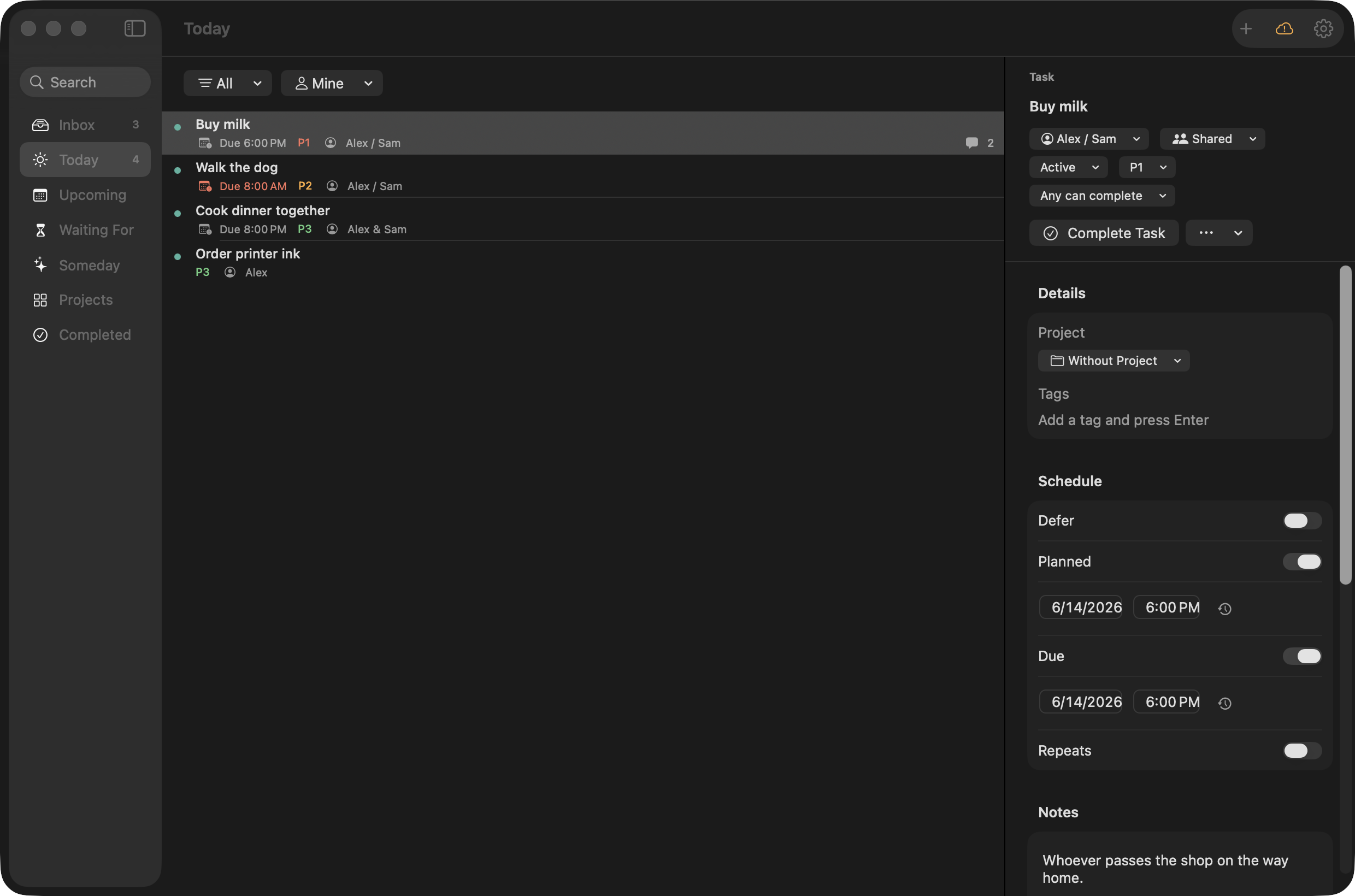
DuetFlow puts ownership into the task itself. With “Any can complete”, anyone responsible can take it, and the first person to finish closes it. With “All must complete”, each person checks off their own part. A private task never leaves your devices or your own iCloud. Each person sees a focused Today view of what is theirs, while the organizer keeps the full GTD system around it.
Where DuetFlow is the wrong choice
DuetFlow runs only on Apple devices: Mac, iPhone, and iPad. If anyone in the household uses Android or Windows, Todoist is the better fit. It isn’t built for work teams or client projects. It is also not public yet, while every other app here is mature and available today. If you rely on OmniFocus perspectives or Things’ polish every day, read the dedicated comparison before you plan a move.
What the extras are worth
Two optional features matter to some households. On the Mac, DuetFlow can connect to a compatible AI assistant through a local MCP connection that runs inside the app: no DuetFlow server, no cloud relay, and you choose what it may see. Todoist offers a hosted MCP server in its cloud instead. And if you use Home Assistant, DuetFlow can pick up a to-do list from it and turn the items into shared household tasks, such as “empty the dishwasher” when the cycle finishes. Neither is required to get value from the app.
The deciding question
Ask who carries the plan today. If the answer is “one of us, in their head and their personal app,” a shared list alone rarely fixes it. The useful change is a system where the next step for each person is visible without anyone relaying it.
DuetFlow early access
One system for your own GTD and the household’s shared work.
DuetFlow is not public yet. Join for private-beta plus launch updates, or choose only the launch announcement. The planned launch price is 29.99 € once with Family Sharing.
Email me early accessDouble opt-in. No analytics or advertising cookies. No behavioural tracking. Research questions are optional.
OmniFocus is a trademark of The Omni Group. Things is a trademark of Cultured Code GmbH & Co. KG. Todoist is a trademark of Doist Inc. Apple and Reminders are trademarks of Apple Inc. DuetFlow is an independent product and is not affiliated with or endorsed by any of them.