Direct answer
A good shared task app for couples should do five things: name responsibility, distinguish “either person” from “both people,” keep progress visible, give each person a focused view, and keep private work genuinely private. If it only shares a list, the coordination work can still stay with one person.
The shared-list trap
A shared list often starts well. Both people can add tasks. Both can complete them. Then the exceptions arrive. The plumber replies in Messages. The appointment moves in Calendar. One person knows that the insurance call must happen first. A recurring responsibility is visible, but nobody knows whether either person can do it or whether both people need to act.
The list still contains tasks, but one person contains the model. They remember the dependencies, assign the vague items, notice what has gone stale, and ask whether something was done. The tool is shared. The management job is not.
Five things worth looking for
1. Ownership that is part of the task
“We need to do this” is not an owner. A task should say whether it belongs to one named person, either person, or both people. That decision needs to stay visible wherever the task appears, rather than living in a comment or an earlier conversation.
2. Completion rules that match real household work
Some tasks are complete when either person acts: collect a parcel, call the plumber, buy milk. Others require independent action from both people: submit two forms, pack two bags, confirm two appointments. Treating both cases as the same checkbox creates ambiguity at exactly the moment the system should remove it.
3. One calm daily view for each person
The person who organizes the household may want Inbox triage, projects, defer dates, Waiting For, and a reliable Today view. The other person may only need to see what is theirs and what either person can pick up. A shared system should support that asymmetry instead of requiring both people to become equally enthusiastic planners.
4. Private and shared work without two separate apps
Work tasks, personal projects, and surprises should not become visible just because the household uses one app. Privacy is stronger when private items stay in a separate private store and only explicitly shared tasks enter the household. The result can still feel like one execution flow to the person using it.
5. A system that carries the next step
A dependable app should keep blocked work out of Today, surface the next available action in a sequential project, and provide a real Waiting For view. Otherwise the household organizer still has to scan every list and reconstruct what is actionable.
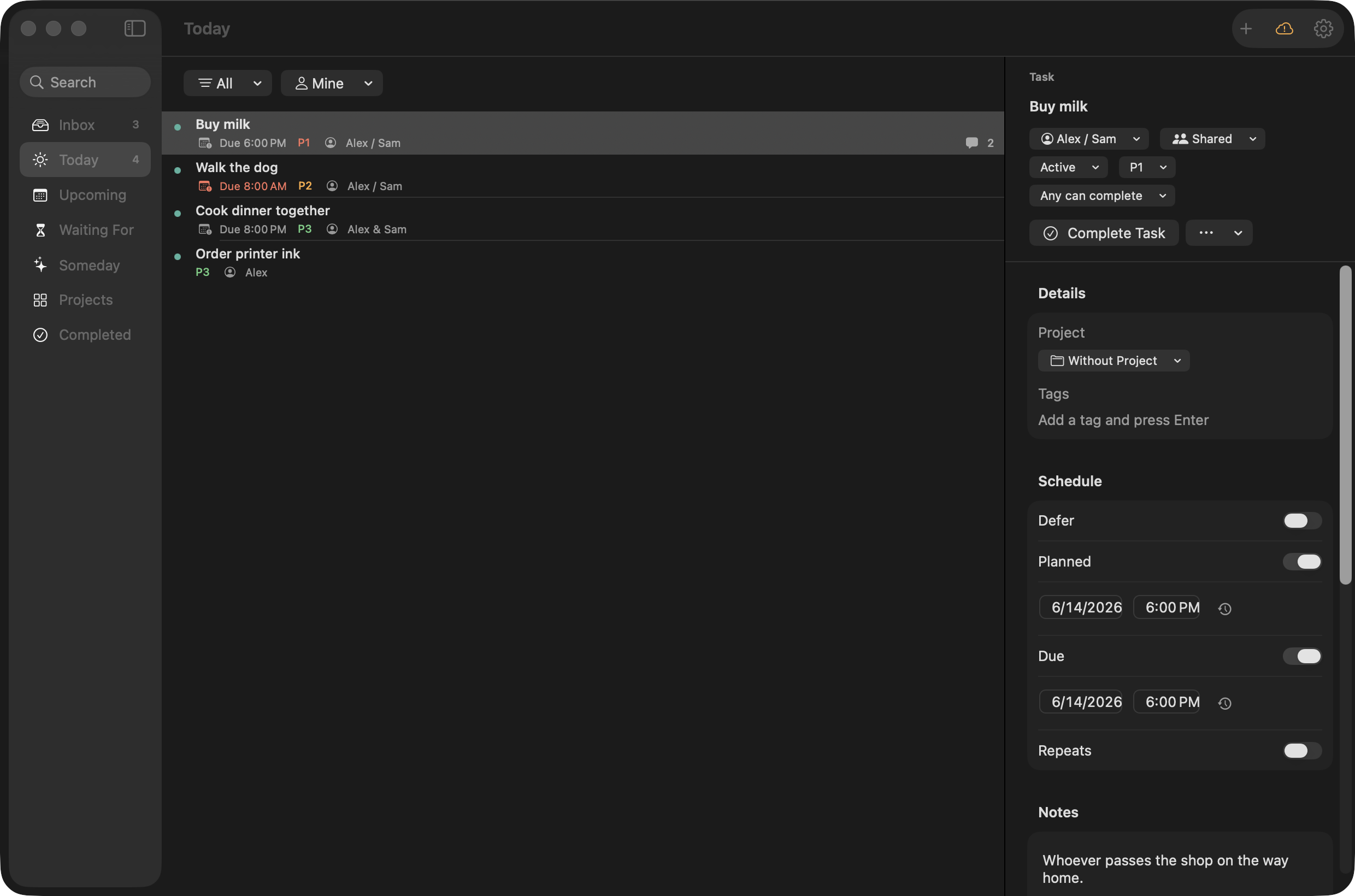
A shared list and a shared responsibility system are different
| Question | Basic shared list | Shared responsibility system |
|---|---|---|
| Who owns this? | Often implied or written in the task | A first-class assignment state |
| Who must complete it? | One shared checkbox | Either person, both people, or one named person |
| What is actionable now? | The people decide by scanning | Availability, blocking, and waiting are part of the model |
| What does each person see? | The same shared list | A focused personal execution view over shared state |
| Where does private work live? | Usually another list or another app | Beside shared work, but outside the shared household store |
What this looks like in DuetFlow
DuetFlow uses four plain-language states. One of us means either person can take the task and one completion closes it. Both of us means each person has an independent part. Just one of us names the owner. Just mine moves the task out of the shared household entirely.
Around that ownership model is a GTD-style system: Inbox, Today, a rolling Upcoming view, Waiting For, Someday, and sequential projects that hold later steps back until they are available. The organizer gets structure. The other person can filter to their own work and participate without maintaining the whole model.
A necessary limit
No app can make two people agree about responsibility. It can make the agreement explicit and preserve it after the conversation, so nobody has to keep translating the same decision into reminders and follow-ups.
Who this approach is for
A basic shared list is enough when the work is small, independent, and easy to remember. DuetFlow is aimed at Apple-only households where shared responsibilities sit beside serious personal or work projects, handoffs regularly cross Reminders, messages, notes, and calendars, and one person has become the default coordination layer.
It is not a workplace team tool, a chore scoreboard, a shopping-list replacement, or a couple-chat app. It is one responsibility system for a household, with a private side for everything that is not shared.
DuetFlow early access
Give the household one dependable responsibility layer.
DuetFlow is not public yet. Join for private-beta plus launch updates, or choose only the launch announcement. The planned launch price is 29.99 € once with Family Sharing.
Email me early accessDouble opt-in. No analytics or advertising cookies. No behavioural tracking. Research questions are optional.