Direct answer
To share household responsibility, define the next action, give it an explicit completion rule, keep its state visible, and let either person see a focused personal view. Do not use a task list as a hidden assignment channel. Agree first, then let the system preserve that agreement so reminders and status checks do not become a second job.
The problem is usually context, not the number of tasks
Household work arrives through conversations, messages, letters, calendars, and things somebody notices while walking through a room. A task such as “sort the insurance” looks small in a list, but one person may know which policy is affected, which document is missing, who called last, and when a reply is expected. The visible checkbox is not the full responsibility.
This is why simply splitting a list in half rarely solves the underlying issue. Equal task counts do not mean equal effort, and a fair household does not require every item to be measured. The more useful aim is reliability: both people can see what they agreed to, the next step is unambiguous, and neither person must repeatedly reconstruct or request the status.
Use four completion rules instead of one vague checkbox
Either of us
One person needs to do it, but it does not matter who. Whoever gets there first can close it for the household.
Both of us
Each person has an independent part. The task is complete only after both have acted.
One named person
The owner is explicit because the responsibility or context genuinely belongs with them.
Private
Personal or work items remain outside the shared household, even when they appear in the same person’s daily flow.
The distinction matters because the same checkbox can otherwise mean conflicting things. An unassigned task might mean either person can do it, nobody has agreed to do it, or both people assume the other person owns it. A visible completion rule removes that translation step.
Make the next action smaller than the responsibility
“Plan the trip” or “fix the heating” names an outcome, not an action. The first useful step may be to choose two dates, find the boiler model, or call one technician. Larger responsibilities should become projects with a concrete next action. Later steps can remain visible without competing for attention before they are available.
Sequential projects are useful here. If the insurance claim needs a photo before the form can be sent, only the photo should appear as actionable. When it is complete, the form becomes next. The system carries the order instead of relying on one person to scan a project and announce the next move.
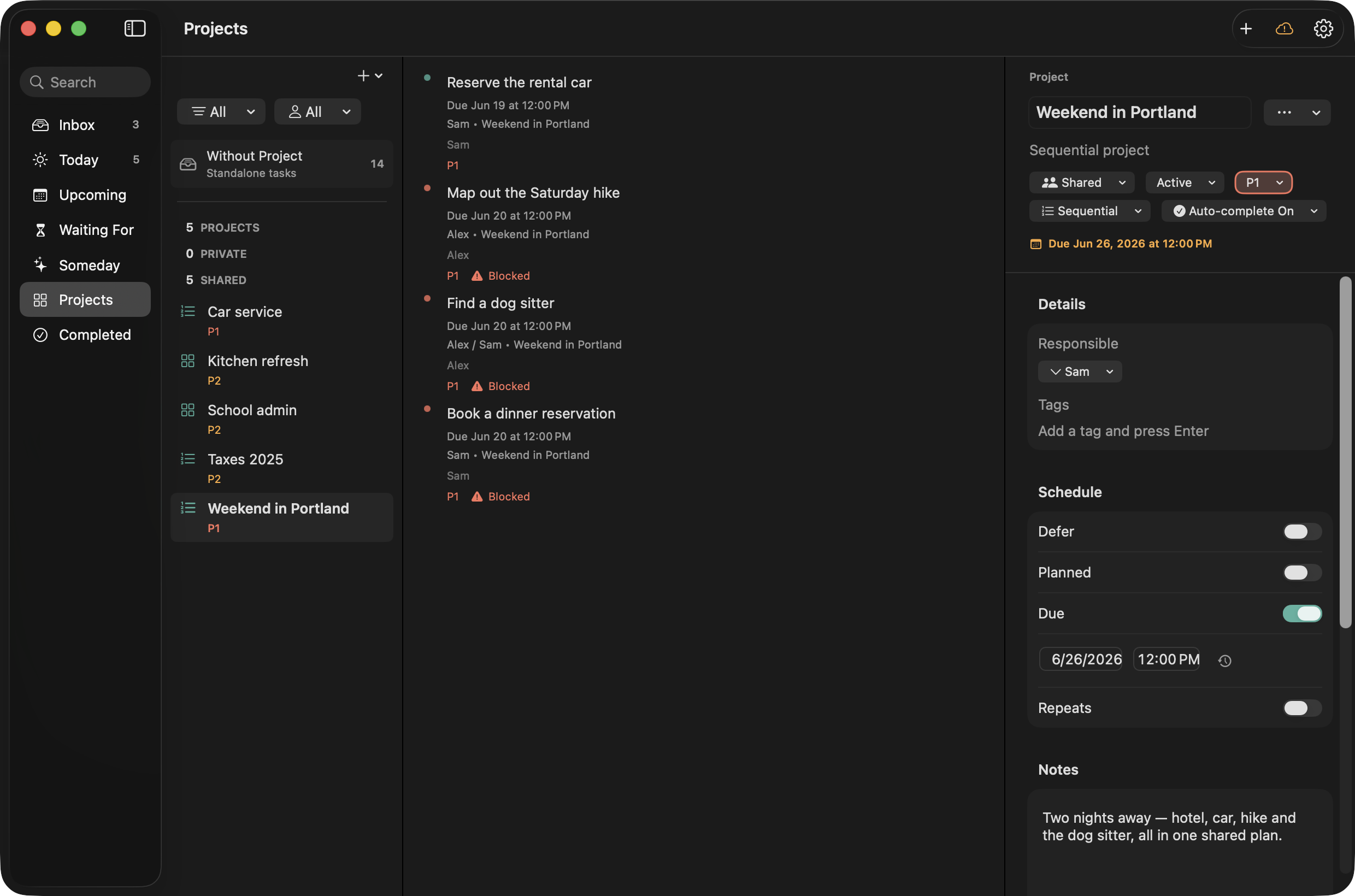
Separate actionable, scheduled, and waiting work
A date should mean that a date is real, not that somebody is afraid of forgetting the task. If a contractor has promised a reply, the task is waiting. If the appointment is on Tuesday, it belongs on Tuesday. If the next call can happen today, it is actionable. Mixing these states creates a long overdue list that both people learn to ignore.
A short shared review can then focus on exceptions: work with no owner, items that have waited too long, and projects with no next action. The system should answer routine status questions on its own. Conversation is still needed for decisions, but not for repeatedly asking whether a known task has moved.
Give each person less system, not the same dashboard
Two people rarely want the same amount of planning detail. One may enjoy maintaining projects and contexts; the other may only need a trustworthy Today view. Requiring both people to operate a complex dashboard creates a new source of resistance. Hiding all structure from the organizer makes the system unreliable.
The better compromise is shared state with focused views. Each person sees what they can act on, what specifically belongs to them, and what both people must complete. The richer project model remains available without making it a daily requirement for both.
A practical setup for two people
- Choose one shared capture point. Put agreed household responsibilities there instead of scattering the same promise across messages, notes, and several reminder lists.
- Clarify the completion rule. Decide whether either person, both people, or one named person must act. Keep private work private.
- Write the next visible action. Replace broad outcomes with something a person can actually begin.
- Use dates and Waiting For honestly. Schedule real commitments and move delegated or pending work out of the active list.
- Review exceptions together. A brief recurring check is enough when the system already preserves ownership and state.
A necessary limit
No task app can negotiate priorities, make an unfair agreement fair, or create willingness where it does not exist. It can reduce accidental ambiguity after two people have agreed and make recurring coordination less dependent on memory.
How DuetFlow applies this model
DuetFlow is an Apple-native GTD-style app designed around two adults. Shared responsibilities sync through Apple’s sharing, while private tasks stay in a separate private store. Inbox, Today, Upcoming, Waiting For, Someday, and sequential projects provide the structure; one-of-us, both-of-us, just-one-of-us, and just-mine preserve the responsibility agreement.
It is intentionally not a chore scoreboard, couple chat, calendar replacement, or workplace team tool. The goal is smaller: one dependable responsibility layer for an Apple household that has outgrown ad hoc handoffs.
DuetFlow early access
Let the system remember the handoff.
DuetFlow is not public yet. Join for private-beta plus launch updates, or choose only the launch announcement. The planned launch price is 29.99 € once with Family Sharing.
Email me early accessDouble opt-in. No analytics or advertising cookies. No behavioural tracking. Research questions are optional.